Why Aren’t We Being Heard? Deaf Community Experiences in Health and Care
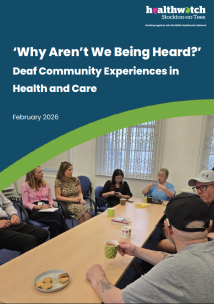
For more than 25 years, members of the Deaf community in Stockton-on-Tees and the wider Tees Valley have been calling for clearer communication, greater understanding, and fair access to health information - yet many feel that little has changed.
The report brings together powerful lived experiences showing that many Deaf individuals still struggle to receive safe, accessible, and respectful care across GP practices, hospitals, pharmacies, and emergency services.
Key issues highlighted in the report
Evidence gathered from local Deaf residents points to systemic and recurring barriers, including:
- Telephone-only access, leading to missed appointments and delays in care.
- Interpreters not being booked, arriving late, or not attending, forcing Deaf patients to rely on friends or family during sensitive medical discussions
- Lack of visual alerts in GP practices and hospitals, resulting in missed appointments or people leaving without being seen.
- Medication errors and misinformation due to poor communication in pharmacies.
- Inconsistent Deaf awareness training, leading to staff not adapting communication even when aware of a patient’s needs.
Many Deaf people described feeling forgotten, ignored, or treated as ‘second‑class citizens’, reflecting a system that still struggles to meet its legal duties under the Accessible Information Standard and Equality Act.
A call for system‑wide change
The report recommends:
- Nationally consistent and enforced accessibility standards
- Mandatory Deaf awareness training for frontline staff
- Clearer processes for booking interpreters
- Use of visual alerts and accessible communication tools in clinical settings
- Investment in sustainable communication support
Healthwatch Stockton-on-Tees will continue working with local services, including NHS Trusts, GPs and Integrated Care Boards, to support improvements and ensure Deaf people’s voices are embedded in decision‑making.
Creating accessibility: a challenge in itself
As part of publishing ‘Why Aren’t We Being Heard? Deaf Community Experiences in Health & Care’, we wanted to make sure the report was accessible for as many Deaf people as possible. During this process, we experienced many of the same challenges that Deaf people themselves face every day.
Creating accessible information for Deaf communities is not simple. Deaf people use a wide range of communication methods, including BSL, SSE, speech-to-text, written English at different literacy levels, and lip‑reading. This means a single format cannot meet everyone’s needs.
We also found that producing high‑quality BSL content requires specialist skills, time, and cost. Creating a BSL version of any document involves trained interpreters, filming, editing, and careful checking for accuracy and cultural relevance.
Alongside this, we faced workforce pressures, interpreter availability issues, and capacity challenges within local Deaf support services.
Our experience highlighted:
- Unclear or inconsistent accessibility guidance
- Limited specialist workforce
- Variation in Deaf awareness training
- Lack of sustainable resource for accessible communication
These barriers mirror what Deaf people reported to us throughout the project.
'Many Deaf people described feeling forgotten, ignored, or treated as ‘second‑class citizens.'
Why we are publishing now
We did not want these challenges to delay the release of this important report. Deaf people have waited long enough to have their experiences heard and recognised.
We have therefore chosen to publish the written report now and are currently developing a full BSL‑signed video version, which will be added as soon as it is ready.
This will ensure the findings are shared without delay, while still committing to accessible formats that meet the needs of the community.
Thank you for your patience as we continue this work.
Thank you to everyone who contributed, your voices are at the heart of this report.
Downloads
You can download the full report below.