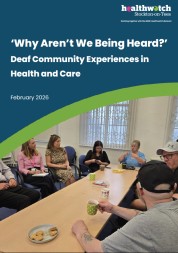
Easy Read: Deaf Community Experiences in Health & Care “Why Aren’t We Being Heard?”
Making Information Accessible
It is hard to make information accessible for Deaf people.
Deaf people communicate in different ways, so one format does not work for everyone.
Why Is It Difficult?
Good BSL information needs:
- A trained interpreter
- Filming and editing
- Checking for accuracy
This takes time, money and skilled people.
What We Found
Healthwatch tried to make information accessible but found:
- Guidance was unclear
- Standards were different
- Work took a long time
- There were practical barriers
Deaf people face these problems every day.
The Big Question
If Healthwatch finds this hard...
How hard is it for Deaf people who rely on clear information?
The system is often:
- Underfunded
- Inconsistent
- Focused on hearing people
What Needs to Change
We believe:
- There should be national rules
- Organisations need proper funding
- Staff need training
- Services must meet different communication needs
Accessibility needs time, money, skills and clear standards.
Good intentions are not enough.
"Good intentions are not enough."
What is this report about?
This report shares real stories from deaf people in Stockton-on-Tees and nearby areas. It shows how hard it can be for deaf people to get good healthcare.
1. Hard to Communicate
- Many services rely heavily on phones for booking appointments or leaving messages, excluding deaf patients entirely
- This leads to missed appointments, delays in care, and increased stress.
2. Phones Only
- Many services only use phones.
- Deaf people miss appointments because they can’t hear phone calls.
3. No Interpreter
- Interpreters are not booked or don’t show up.
- Deaf people have to ask family or friends to help, even for private health issues.
4. Hospitals and GPs
- Names are called out with no visual signs.
- Some people leave early because they feel left out.
- A few places like Elm Tree and Specsavers were praised for
being helpful.
5. Pharmacy Mistakes
- Deaf people get the wrong medicine because of poor communication.
How Does This Make People Feel?
“Like I’m bottom of the pile.”
“Just forgotten about.”
“Like a second-class citizen.”
What Needs to Change?
Use Plain Language
- Interpreters are not booked or don’t show up.
- Deaf people have to ask family or friends to help, even for
private health issues.
Use Visual Signs
- Screens with subtitles.
- Flashing lights or signs when calling names.
Train Staff
- Teach staff how to talk to deaf people.
- Show how to book interpreters.
Deaf Liaision Officers
- Have someone in each service to help deaf patients.
Communication Support Files
- Keep a file with tips on how to help deaf people.
Visits to Learn
- Let deaf people visit hospitals to learn how things work.
Follow the Law
- Services must follow the Equality Act and Accessible Information Standard.
Who Books The Interpreter?
GPs
- The local NHS team or ICB should help book interpreters.
Hospitals
- The hospital must book interpreters. Patients should not have to do this
What’s Next?
Healthwatch Stockton-on-Tees will:
- Visit health and care places with deaf people.
- Share what works well and what needs to improve.
Want to Help?
If you are deaf or have hearing loss and want to share your story, contact:
info@healthwatchstocktonontees.co.uk
Thank you
Thank you to everyone who shared their story. Your voice matters. Together, we can make health and care better for deaf people.
You can download the Easy Read report below.